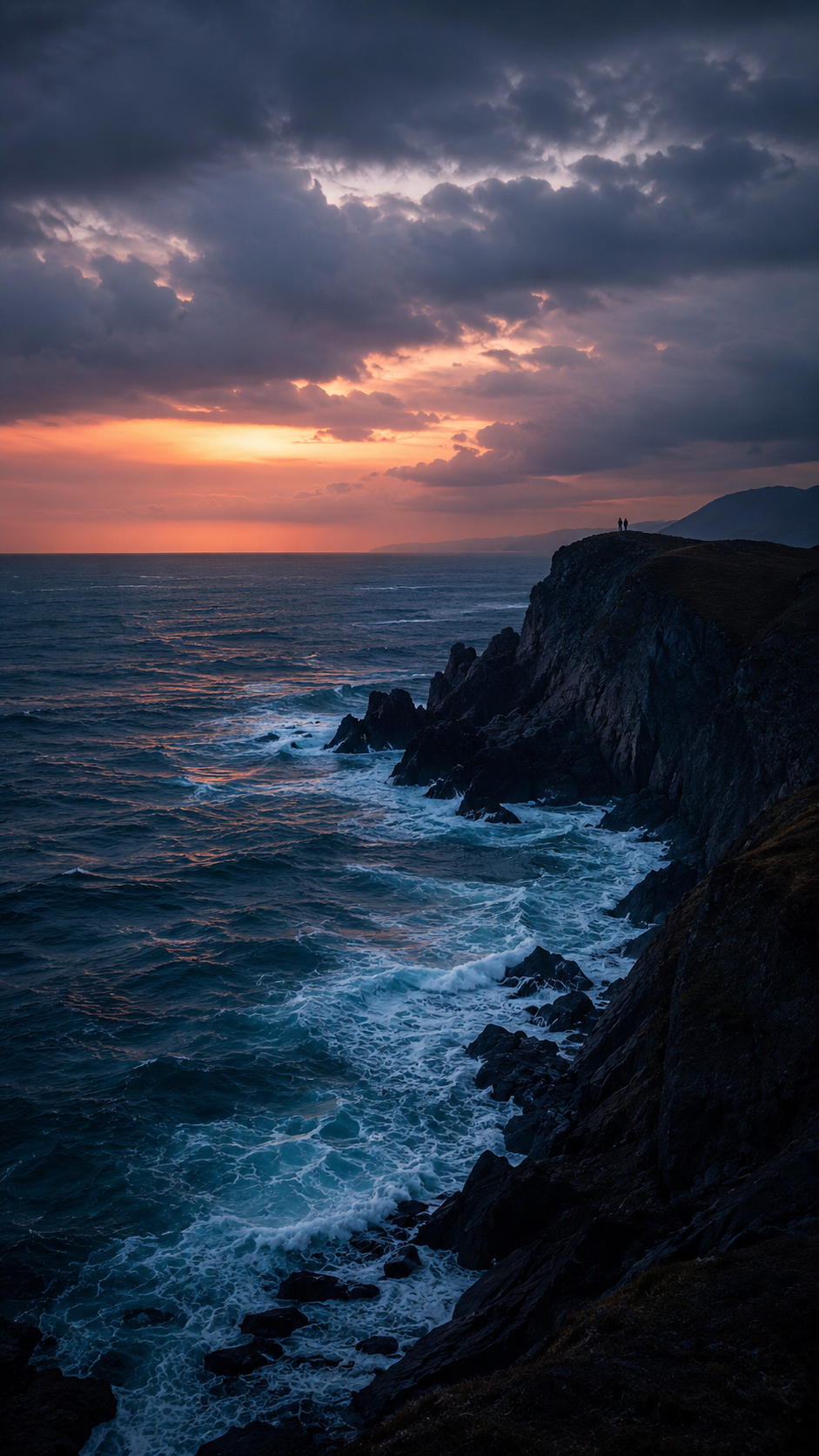
Water does not argue with the world.
It does not arrive clenched, armored, determined to prove itself against every stone. It does not mistake resistance for purpose. It does not confuse noise with power.
Water studies.
The shape of the shore.
The mood of the wind.
The hidden slope beneath the surface.
The patience of rock.
The hour when pressure becomes movement.
Then, without spectacle, it becomes exactly what the moment requires.
Still enough to hold the sky.
Strong enough to enter stone.
Soft enough to carry light.
Relentless enough to redraw the earth.
That is the first lesson.

Power does not always come with impact.
Sometimes it comes as return.
Again and again, the wave meets the cliff. Not violently at first. Not triumphantly. Just faithfully. Touch after touch. Year after year. The cliff believes itself permanent because stone is always the last to understand change. But water knows better.
Water understands that permanence is often only slowness mistaken for truth.
It does not need to win immediately.
It knows how to outlast.
There is an intelligence in that kind of patience. A kind the world rarely applauds because it is not dramatic enough to look impressive. We have been taught to admire the hard thing. The sharp thing. The thing that enters a room like a verdict. We call it strength when someone refuses to bend, when they stand unmoved, when they make themselves difficult to touch.
But rigidity is not always strength.
Sometimes it is fear wearing armor.
Sometimes it is exhaustion pretending to be discipline.
Sometimes it is the desperate hope that if nothing changes, nothing can be lost.
Water is not afraid of changing form.
That is why it survives.
It can be sea, rain, mist, river, flood, fog, ice, tear, current, tide. It can disappear from one place and gather itself in another. It can fall from the sky and still return to the ocean. It can become invisible and remain inevitable.
A wave does not fail because it breaks.
The tide does not apologize because it retreats.
The sea does not lose itself because the surface is restless.
It knows that motion is not betrayal.
It knows that becoming is not the same as being lost.
Perhaps that is what makes water so difficult to understand for those who worship control. It does not possess the world, yet the world yields to it. It does not hold one shape, yet nothing can erase it. It does not harden to endure, yet it enters every opening.
It teaches a severe and beautiful truth:
adaptation is not surrender.
Fluidity is not weakness.
Stillness is not absence.
And softness, when it knows itself, can be one of the most durable forces on earth.

The ocean can look almost innocent beneath a blue sky. A wide, glittering mercy. A body of light breathing under clouds. Then evening comes, and the same water darkens. It gathers weight. It rises with an old authority. It reminds the body that beauty has never been the same as harmlessness.
This, too, is a lesson.
To be gentle is not to be powerless.
To be calm is not to be empty.
To be quiet is not to be conquered.
There are minds like this.
Oceanic minds.
They do not rush to answer every provocation. They do not offer their energy to every storm that knocks at the door. They have learned that not every wave deserves the body. Not every insult deserves language. Not every crisis is an instruction to abandon oneself.
They wait.
Not because they are passive.
Because they are listening.
There is a difference.
Waiting, when it is conscious, is not idleness. It is perception. It is the discipline of not moving before the truth has surfaced. It is the refusal to turn panic into strategy. It is the rare ability to stand inside uncertainty without immediately manufacturing a false answer just to feel less afraid.
The surfer knows this.
From the shore, he may look fearless. Balanced inside a blue cathedral of force, small against the moving wall. But his grace is not domination. It is timing. He does not command the wave. He reads it. He studies the breath of it, the lift, the pull, the invisible architecture gathering beneath him.
Too soon, and the sea refuses.
Too late, and the sea decides.
At the right moment, there is no conquest.
Only alignment.

Life is often like this.
The mistake is thinking every season must be forced open. Every door pushed. Every silence filled. Every uncertainty solved by the violence of immediate action. But some things cannot be rushed without being ruined. Grief has its own tide. Becoming has its own weather. Clarity is not always a lightning strike. Sometimes it is sediment settling after the water has been disturbed.
A person must learn when to move.
And when to let things pass.
This is not resignation.
It is discernment.
There are storms that are meant to be entered. There are others meant to be watched from a distance until they spend themselves. There are moments that ask for courage, and moments that ask for restraint. There are seasons where the most powerful thing one can do is not strike, not explain, not chase, not plead — but remain clear.
Clear enough to see.
Still enough to understand.
Fluid enough to become.
The water mind knows that life is not a straight road but a system of tides. Advance. Retreat. Return. Dissolve. Gather. Rise. Begin again.
It does not panic at repetition.
It does not see return as failure.
It understands that some lessons come back because they were never fully absorbed. Some patterns repeat because the self has not yet learned another shape. Some waves arrive not to punish, but to reveal what still cannot float.
To be wise is not to be untouched.
It is to be altered without being destroyed.
The sea is never the same sea twice, and still it remains the sea.
That is the paradox.
That is the grace.

A human life asks for the same fluency. There will be years that make stone of you if you let them. Years that ask you to become hard enough to survive and then forget to teach you how to soften again. Years that praise your armor because your tenderness would make others uncomfortable.
But the deepest strength is not the one that never bends.
It is the one that bends and returns with knowledge.
The one that can soften without disappearing.
The one that can yield without handing itself away.
The one that understands the difference between being shaped by life and being owned by it.
Water accepts contact, but not captivity.
It touches everything and belongs to itself.
It reflects the sky without becoming the sky. It carries the moon without mistaking borrowed light for its own. It receives the storm, the ship, the body, the prayer, the wreckage — and still keeps its ancient direction.
There is sovereignty in that.
Not the loud kind.
The elemental kind.
The kind that does not need applause because it is too busy being real.
Perhaps that is why the sight of open water rearranges something inside us. It restores scale. It humiliates the ego gently. It tells the nervous system, without words, that not every horizon is meant to be possessed. Some are meant to be witnessed. Some are meant to remind us that mystery is not an enemy simply because it cannot be managed.
Stand before the ocean long enough and something in you loosens.
The performance thins.
The urgency fades.
The small, frantic self grows quiet beneath the larger weather of existence.
You remember that you are not the center.
Then, if you stay a little longer, you remember that this does not make you meaningless.
A single drop is not the sea.
But the sea is not itself without every drop.

That is the strange mercy of water: it humbles without erasing. It teaches scale without cruelty. It says: you are small, yes — but not separate. You are temporary, yes — but not irrelevant. You are not here to control every tide. You are here to learn your own movement inside it.
There is freedom in that.
A hard freedom.
The kind that asks a person to stop performing solidity and begin practicing truth.
To stop calling every defense a boundary.
To stop mistaking tension for strength.
To stop believing that peace must mean nothing is moving.
Because peace is not always still water.
Sometimes peace is the wave that knows where it is going.
Sometimes it is the storm that has stopped apologizing for its size.
Sometimes it is the tide leaving without shame, certain of its return.
And sometimes it is the quiet decision to stop fighting the shape of your life and begin studying it.
Where does it pull?
Where does it resist?
Where does it ask you to soften?
Where does it ask you, finally, to rise?
The water mind does not demand an easier world.
It becomes more exact inside the one it has.
It learns what to meet, what to outlast, what to release, what to carry, what to leave on the shore.
It learns the dignity of motion.
The holiness of patience.
The ferocity of softness.
The intelligence of not breaking against everything hard.
Water does not fight the world.
It listens to it.
It enters it.
It changes with it.
And slowly, without permission, without noise, without needing to be believed,
it changes the world back.